August 15, 2026 • Callum Reeve • 10 min reading time • Specs verified June 5, 2026
Camp Choppers and Fixed Blades for Heavy Outdoor Work: Machetes, the KA-BAR, and the Kershaw Camp 10
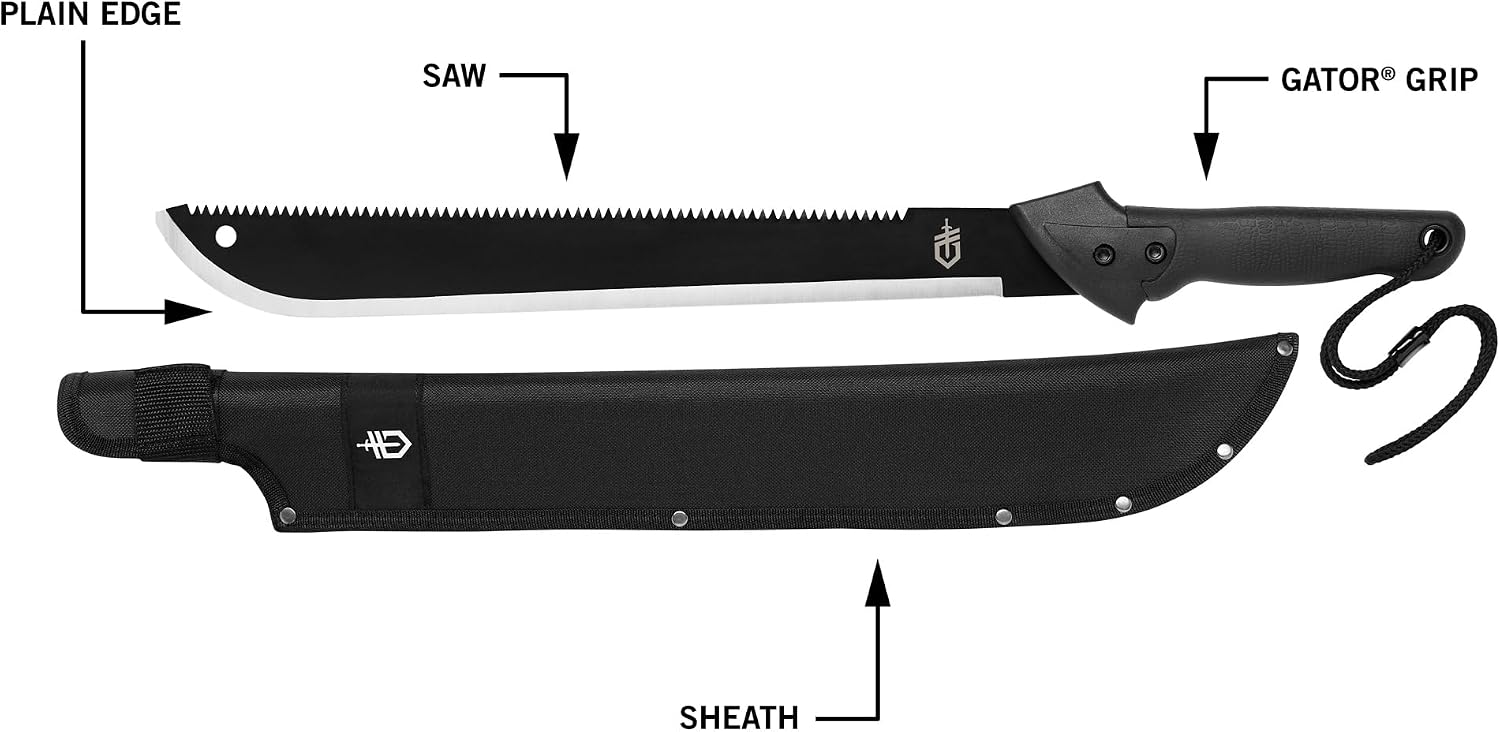
If you’re standing in the sporting-goods aisle trying to figure out whether you need a machete, a big fixed blade, or something in between for serious camp work, you’re not alone — and the answer actually matters. A fixed blade is simply a knife with no folding mechanism; the blade is permanently attached to the handle, which makes it stronger and easier to clean than a folding knife. A machete is a long, thin cutting tool (usually 14–24 inches overall) designed specifically for slashing through vegetation, vines, and light brush. A camp chopper sits in between: heavier than an ordinary hunting knife, shorter and more controllable than a full machete, built to split kindling, baton (drive a blade through wood by striking the spine with a stick), and clear a campsite. This article maps three distinct tools — the Gerber Gator Machete at the budget end, the KA-BAR Becker BK2 as a proven mid-tier workhorse, and the Kershaw Camp 10 as an underrated value — against real buyer testimony, then explains the metallurgy and geometry tradeoffs that determine which one belongs in your kit.
| EDITOR'S PICKGerber Gear StrongArm Fixed Bla… | Mid-tierKA-BAR 1220 US Army Straight Ed… | Budget pickMachete with Saw 25" / 19" Heav… | |
|---|---|---|---|
| Blade length | — | 7" | 25" / 19" |
| Sheath included | — | ✓ | ✓ |
| Edge type | Plain | Straight edge | Serrated |
| Made in USA | ✓ | — | — |
| Handle type | — | — | No-slip |
| Price | $109.99 | $103.95 | $28.89 |
| See on Amazon → | See on Amazon → | See on Amazon → |
The Budget Rung: Gerber Gator Machete and What Sub-$20 Actually Gets You
Let’s be honest about what the Gerber Gator Machete is: it’s a consumable. Reviewers aggregated on Outdoor Life’s machete buyer guide and on Gear Junkie’s camp-tools roundups are strikingly consistent — people who buy the Gator for brush clearing, trail maintenance, or bug-out redundancy know exactly what they’re getting. At the sub-$20 price point in early 2026, it clears vegetation, handles light limbing, and survives a camping season. Nobody is calling it a precision instrument.
The blade steel is a mid-carbon alloy in the neighborhood of standard 1055 or similar commodity carbon steel — tough enough to take abuse without shattering, but soft enough that it dulls faster than premium steels and requires regular touch-ups. The rubber overmold handle works well in wet conditions, and the nylon sheath is functional if unspectacular.
Where budget machetes fail most people isn’t the blade — it’s handle durability under sustained chopping stress. Long-run reviewers frequently note that the handle-to-blade junction on cheaper models is the failure point when the tool is used hard over multiple seasons. This is exactly why one multi-year reviewer on aggregated platforms specifically called out an unnamed competitor machete-with-saw-spine as a replacement for a pricier model whose handle came apart: handle integrity under real field stress is a genuine differentiator even at this price tier, and it’s worth checking user reviews specifically for handle longevity before you buy.
The Gator’s honest verdict: If your use case is occasional brush clearing on a camping trip and you want something you won’t grieve if it gets lost or beaten up, the value-per-dollar math is real. If you’re doing this weekly or professionally, spend more.
The Mid-Tier Workhorse: KA-BAR Becker BK2 and the Convex Grind Question
The KA-BAR Becker BK2 — designed by Ethan Becker and manufactured by KA-BAR — is one of the most-discussed camp knives on BladeForums.com, with multi-year owner threads stretching back to the mid-2010s. It comes up repeatedly in conversations about “best all-around camp knife under $80” and has earned a reputation as nearly indestructible in bushcraft applications.
But there’s a specific confusion that surfaces in reviews so regularly that it deserves a full explanation: the BK2 blade feels dull when you drag a finger across the edge, yet it shaves arm hair and passes newspaper-slicing tests cleanly. What’s going on?
The answer is the convex grind — and it’s not a defect. Most production knives use a flat or hollow grind (where the bevels are flat planes or concave curves meeting at the edge). A convex grind curves outward from the spine to the edge, creating a geometry that’s thicker behind the cutting bevel. When you run your finger or thumbnail laterally across a convex edge, the geometry feels rounded rather than “bitey.” But that same geometry creates more steel behind the edge, which is what gives the BK2 its exceptional toughness for batoning and heavy chopping — the edge is less likely to chip or roll under lateral stress.
Larrin Thomas at Knife Steel Nerds has written extensively about how edge geometry (not just steel hardness) determines field durability, and the convex grind principle is central to why tools like the BK2 outlast thinner-ground alternatives in hard-use applications even at the same steel hardness.
The BK2 runs 1095 Cro-Van steel — a well-understood high-carbon alloy that takes and holds a working edge reliably, patinas naturally, and is easy to sharpen in the field with a basic whetstone. It is not a stainless steel, which means it will rust if neglected. Wipe it dry, give it a light coat of mineral oil or food-safe oil after wet work, and it will last decades.
By the Numbers — BK2 Quick Spec Check:
- Blade length: 5.25 in | Overall: 10.5 in
- Steel: 1095 Cro-Van, ~57 HRC
- Weight: 13 oz (with sheath)
- Sheath: MOLLE-compatible hard plastic
The Underrated Middle: Kershaw Camp 10 and Why Its Sheath Changes the Equation
The Kershaw Camp 10 sits in unusual territory: at around 10 inches of blade on a roughly 16-inch overall tool, it’s too long to classify as a camp knife and too short and heavy to be a true machete. Think of it as a cross between a large camp chopper and a light parang (a Southeast Asian chopper with a slightly curved, top-heavy blade profile). And it punches well above its price tier.
Multi-year owners — including at least one buyer who purchased the Camp 10 originally as a gift for a parent and eventually bought their own after years of hearing consistent positive feedback — describe a tool that handles kindling splitting, light limbing, and vine clearing without the arm fatigue of a heavier tool. The 65Mn carbon steel blade (more on this in the FAQ below) is hardened to a range that trades some ultimate edge retention for improved toughness, which is the right call for a chopping tool.
But the detail that shows up in Knife Informer’s review and in aggregated owner feedback more than almost anything else is the sheath. In a category where sheaths are almost universally criticized — too loose, wrong belt loop angle, rattles, doesn’t retain — Kershaw’s Camp 10 sheath gets described in terms usually reserved for custom leather work: “spot on perfect” is a phrase that recurs. The fit is snug without requiring a snap, the carry angle works for both belt and pack-strap mounting, and the drain hole is correctly positioned. For a tool this size, a good sheath isn’t a luxury; it’s a safety feature. Getting this right at the Camp 10’s price point is genuinely unusual.
One honest caveat: The Camp 10’s 65Mn steel, like most carbon steels, will surface-rust if left wet. Field users who don’t maintain it will find orange spots within a season. Wipe it down, and it’s a non-issue.
The Gerber StrongArm and Price Creep: An Honest Reckoning
No article covering this category in 2026 can ignore the Gerber StrongArm conversation, because buyers keep having it. The StrongArm — a 4.8-inch fixed blade with a rubberized handle and 420HC stainless steel — was a clear value proposition when it sold around $50–$55. At current street pricing of $100 and up, the calculus has shifted.
One frequently cited reviewer paid $51 in 2018 and explicitly states they would not consider the knife good value at the current price point. That’s not a marginal opinion — it reflects a pattern in the aggregated review data. At $50, the StrongArm competed well against comparable blades on toughness, handle ergonomics, and sheath quality. At $100+, it competes against the lower range of ESEE and Mora Garberg territory, where the steel quality, edge geometry, and overall execution are meaningfully better.
The honest verdict: If you find the StrongArm on sale below $70, it’s a capable camp knife. At $100+, the BK2 or a Mora Garberg in the same price window is a stronger choice for nearly every buyer in this category.
Frequently Asked Questions
What is the real difference between 65Mn carbon steel and standard camp knife steel for chopping tasks?
65Mn is a manganese-alloyed spring steel common in Chinese production blades. Per Knife Steel Nerds’ published alloy comparisons, the manganese addition increases toughness and hardenability compared to simpler 1050-class carbon steels. For chopping, this matters: 65Mn blades tend to flex and recover rather than chip or crack under lateral stress. The tradeoff is that 65Mn doesn’t achieve the same peak edge sharpness as higher-carbon Western alloys like 1095. For a machete or camp chopper where you’re prioritizing durability over slicing refinement, it’s a reasonable steel choice at the price point.
Does a machete saw spine actually work for cutting branches, or is it decorative?
It works, but with caveats. A properly cut saw spine (sharp, well-set teeth) can cut through green wood branches in the 1–2 inch diameter range effectively — it’s not decoration. The limitation is that the teeth on most production machete saw spines are relatively coarse and shallow, which means they bind in green wood faster than a dedicated folding saw. For emergency use or occasional light work, it’s genuinely functional. For sustained fire-prep or camp construction, a dedicated folding saw will outperform it. Long-run field reviewers on Outdoor Life’s machete guide consistently rate the saw feature as “useful backup, not primary tool.”
How do you sharpen a machete in the field with basic tools?
The simplest field-capable method is a medium-grit puck (a round sharpening stone shaped like a hockey puck) or a flat diamond paddle. Work the bevel angle that’s already on the blade — typically 20–25 degrees on most production machetes. Set the stone at that angle against the bevel and push forward along the length of the edge in smooth, consistent strokes, working from handle to tip. A few passes per side every hour of hard use will keep a carbon-steel machete cutting clean. If you have nothing else, the unglazed ceramic ring on the bottom of a mug will serve as an emergency honing surface for touch-ups.
Why does the KA-BAR blade feel dull when you run a finger across it if it is actually sharp?
This is the convex grind effect described above. A convex grind curves outward from spine to edge, creating geometry that your fingertip reads as “rounded” rather than bitey. The edge itself is acute and sharp — it will shave hair and cut cleanly — but the geometry behind the edge is thicker than on a hollow-ground blade. That thickness is what provides the toughness for batoning and chopping. The BK2 isn’t dull; it’s shaped differently from what most people’s fingertips expect.
Is the Gerber StrongArm still worth its current price compared to the competition?
At $100+, no — not when alternatives like the KA-BAR Becker BK2 and Mora Garberg offer better steel specifications and comparable or better execution in the same price window. The StrongArm was a strong value at its original $50 price point. Price creep has moved it into a tier where buyers are better served by purpose-built camp knives from makers with stronger steel pedigrees. If you can find it on clearance below $70, it’s a capable knife with real-world field credentials. At full current retail, look elsewhere first.