September 8, 2026 • Callum Reeve • 11 min reading time • Specs verified June 5, 2026
The EDC Fixed Blade Question: ESEE Izula-II, Small Carry Knives, and When a Fixed Blade Beats a Folder
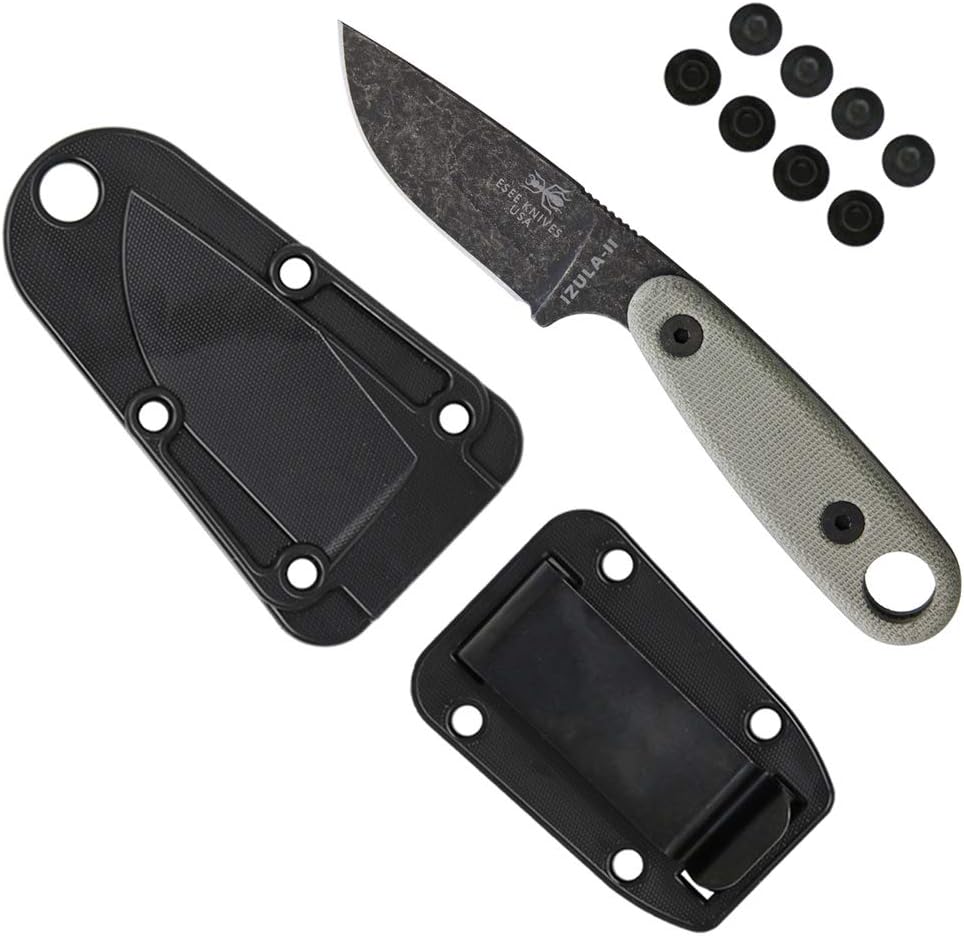
Most people who carry a knife every day — “EDC” in the hobby shorthand, meaning the one tool you actually have on you when something needs cutting — carry a folding knife. A folder opens with one hand, rides flat in a pocket, and doesn’t raise eyebrows. That’s a real advantage. But a fixed blade, which has no moving hinge and a blade permanently attached to the handle, is stronger, faster to deploy in two hands, and easier to clean after hard use. The question isn’t which design is universally better. The question is whether a fixed blade is better for you — and if so, which one. This guide focuses on the small end of the fixed-blade world, the pocket-sized or neck-carry knives that have earned genuine loyalty from EDC devotees who’ve been down the folder road already and came back wanting something different.
If you’re already sold on fixed blades and just want the comparison, skip ahead. If you’re on the fence, stay here — this is exactly the decision we’re going to work through.
| EDITOR'S PICKKA-BAR Becker Kephart Fixed 5.1… | Mid-tierESEE PR4 Fixed Blade Survival K… | Budget pickMorakniv Carbon Steel Fixed-Bla… | |
|---|---|---|---|
| Blade Length | 5.1 in | — | 4.3 in |
| Blade Steel | Carbon Steel | — | Carbon Steel |
| Handle Material | Walnut | — | — |
| Overall Length | 9.688 in | — | — |
| Sheath Included | — | ✓ | ✓ |
| Fire Starter | — | — | ✓ |
| Price | $151.00 | $130.35 | $53.92 |
| See on Amazon → | See on Amazon → | See on Amazon → |
Fixed Blade vs. Folder for EDC: The Honest Tradeoff
Let’s be direct about what folders do better: one-handed deployment, pocket carry without a visible belt clip or sheath, and social acceptability in most workplaces. If your daily environment involves offices, meetings, or people who’d find a sheath on your belt alarming, a folder is almost certainly still your answer.
What fixed blades do better is narrower but important. There’s no pivot to fail, no lockup to wear out, no mechanism to gum up with pine sap or blood or grit. The blade-to-handle junction is solid, which means you can apply torque and pressure that would stress a folder’s lock. Deployment is genuinely faster when both hands are involved — which matters in cold, gloved, or urgent situations. And at the small end of the market (3-inch blades or under), you’re not giving up much practical carry comfort compared to a chunky folder.
The reviewers who stick with EDC fixed blades long-term tend to share a profile: they work outdoors, they camp seriously, or they’ve simply built a carry system — belt, sheath position, clothing choice — around a fixed blade until it became invisible. One Izula-II owner documented on Blade Forums described wearing a fixed blade more than 18 hours a day across a collection of over 50 working knives, using the Izula-II as the benchmark against which he measured smaller knives. That’s not a beginner’s perspective. That’s someone who has eliminated every friction point through repetition.
The ESEE Izula-II: Why It Became the Benchmark
The Izula-II is a neck knife — small enough to wear on a cord around the neck or tucked into a sheath clipped horizontally at the belt — with a 2.63-inch blade in 1095 high-carbon steel and a skeletonized handle that accepts optional micarta or G10 scales. The “II” designation means it comes with those scales already installed, giving you a knife that’s genuinely grippable rather than just a bare steel skeleton.
By the numbers:
- Blade: 2.63 inches, 1095 carbon steel, flat grind
- Overall length with scales: 6.125 inches
- Weight: ~2.9 oz with scales
- Price range (as of mid-2026): roughly $70–$85 depending on color and configuration
That price is where the Izula-II creates its most interesting tension. Multiple reviewers across Blade Forums and Knife Informer’s fixed-blade EDC coverage have noted the same thing independently: the Izula-II feels slightly expensive for what is, on paper, a small piece of stamped 1095 steel with a polymer sheath. And then they immediately explain why they bought it anyway. The ESEE lifetime warranty — which covers any damage, manufacturing or user-caused, without qualification — changes the cost math completely. You are not buying a $80 knife. You are buying guaranteed blade replacement at cost-of-return-shipping for as long as ESEE exists as a company. Reviewers who’ve actually submitted warranty claims report the process as frictionless. That’s not a marketing claim; it’s documented owner experience across aggregated forum testimony.
The 1095 steel is worth discussing honestly, because it’s the one spec that draws the most questions from buyers migrating from stainless folders. 1095 is a simple high-carbon steel that takes an excellent edge and sharpens easily on basic stones. It also rusts faster than stainless alloys if you let it sit wet. In practice, owners who carry Izula-IIs daily report that a quick wipe-down after use and an occasional light oil application is sufficient — less care than their leather boots. The concern about 1095 being “too high-maintenance” is mostly theoretical for someone who’s already disciplined about their gear. If you’re not that person yet, the Izula-II will teach you to be or punish you for not being. That’s honest.
The Competition: Morakniv Garberg, KA-BAR Kephart, and ESEE PR4
The Izula-II doesn’t exist in isolation. Three knives come up repeatedly in the same conversations, and they each represent a meaningfully different approach.
Morakniv Garberg — Mora’s premium full-tang fixed blade (most Morakniv models use a partial or rat-tail tang; the Garberg is full-tang throughout, meaning the steel runs the full width of the handle). Reviewers at Gear Junkie and on Blade Forums have noted Garberg owners in genuinely wet environments — the Pacific Northwest specifically comes up repeatedly — describing the integrated ferro rod striker notch on the polymer sheath as a functional feature, not a gimmick. In sustained rain conditions where a separate ferro rod becomes an item to track, having it built into the sheath matters. The carbon-steel Garberg offers real full-tang durability at a price point below the Izula-II, making the honest question: is full-tang Mora worth the premium over the standard Companion? The answer depends on what you’re doing. If you’re batoning wood or doing prying tasks, yes — the Garberg’s construction handles it and the Companion’s partial tang is a real limitation under stress. For light EDC cutting, the Companion is more knife than you need for less money, and the Garberg is the upgrade you make when you know you want it.
KA-BAR Becker Kephart — This knife occupies a genuinely different niche. It’s larger than the Izula-II (4-inch blade), which puts it at the top edge of what most people would call EDC carry, but it draws a specific type of buyer: the historically-minded outdoorsperson who came to it through Horace Kephart’s 1917 book Camping and Woodcraft and wanted a tool with traceable lineage. Outdoor Life’s coverage of the Kephart notes its appeal to bushcrafters who want a do-everything camp knife that also rides on the belt daily. If you’re in that camp, the Kephart is excellent. If you want something genuinely small enough to carry without thinking about it, the blade length pushes it out of the Izula-II conversation.
ESEE PR4 — ESEE’s own step up from the Izula-II in blade length (3.5 inches) with a different handle geometry. One reviewer documented on Blade HQ’s Q&A section described owning an ESEE-5 that had seen use across three continents before returning specifically to buy the PR4 for its handle design. The ESEE-5 is a full survival knife; the PR4 sits in a middle ground between utility and packability. If the Izula-II feels too small for your actual use cases — you’re doing camp food prep, not just opening packages — the PR4 is the natural next step within the same warranty ecosystem.
Carry Comfort: The Part Nobody Talks About Honestly
Fixed-blade EDC fails or succeeds on sheath and carry position, not blade quality. A great knife in a mediocre sheath that shifts, prints through clothing, or catches on seat belts will get left at home within a month.
The Izula-II ships with a polymer sheath that can be configured for neck carry (on a cord), horizontal belt carry, or vertical drop. Owners who’ve committed to it long-term consistently report that horizontal carry at the 3 o’clock or 9 o’clock belt position — blade pointing toward the back — prints the least under a tucked shirt or light jacket. Neck carry works for lighter tasks and lighter clothing, but the knife migrates more with physical activity than belt carry does.
If you’re new to fixed-blade carry, the practical advice from experienced owners is: wear it at home for a week before committing to a position. The sheath that feels natural when you’re standing still feels different when you’re driving, bending, or sitting at a desk. Most people iterate through two or three carry positions before they find the one that disappears into the day.
The Legal Question (Because You Should Know)
Fixed-blade carry legality in the United States is genuinely state-by-state and sometimes city-by-city, and we’d be doing you a disservice to oversimplify it. The broad pattern: most states permit fixed-blade carry when the knife is carried openly (visible in a sheath), but many restrict concealed fixed-blade carry more aggressively than concealed folders. Blade length restrictions exist in some jurisdictions. Some states have specific exemptions for hunting and fishing contexts.
The practical advice: look up your specific state statute (most state legislatures publish these online) and, if you’re in a city with its own municipal code, check that separately. Knife Rights (the organization) publishes a state-by-state legal summary that is more reliable than any summary we can offer here, given how frequently municipal codes change. Carry what you can carry legally where you actually are — the best fixed blade in the wrong jurisdiction is a liability.
Frequently Asked Questions
Is it legal to carry a fixed blade knife as an everyday carry item in most US states? Open carry of a fixed blade is legal in many states; concealed carry rules vary significantly. There’s no single national answer. Check your state statute and local municipal code before committing to a carry method.
Does the ESEE lifetime warranty cover user damage or just manufacturing defects? ESEE’s published warranty covers any damage — including user abuse — without qualification. Owners who’ve submitted claims for broken tips and damaged sheaths report the process as straightforward. This is a genuine differentiator from most knife warranties, which cover only manufacturing defects.
Is the Morakniv Garberg full-tang construction worth the price premium over the standard Companion? For light cutting tasks, the Companion is hard to beat on value. If you’re batoning, prying, or doing sustained hard camp use, the Garberg’s full-tang construction is the right call. The gap narrows when you factor in what you’re actually doing with the knife.
How do you carry a small fixed blade comfortably without it printing or shifting throughout the day? Horizontal belt carry at a strong-side or support-side position generally prints the least. Experiment with position for a week before committing. Third-party Kydex sheath makers produce options for the Izula-II if the factory sheath doesn’t work for your body type or clothing preference.
Is 1095 carbon steel too high-maintenance for a knife used every single day in varied conditions? Not for most disciplined users. A wipe-down after wet use and occasional light oil application is sufficient. Owners in humid and wet climates report manageable patina development without functional rust when basic care is practiced. If you want zero maintenance steel, look at knives in S35VN or similar stainless alloys — at higher price points — rather than dismissing 1095 before trying it.
The Decision Rule
If X, then Y:
- If you want the most proven small fixed blade with a bulletproof warranty and you can accept 1095 carbon steel care: the Izula-II is the benchmark for a reason.
- If you’re in a wet environment and want sheath-integrated ferro rod capability with full-tang construction at a lower price: the Garberg earns its position.
- If you want a historically grounded camp and belt knife that doubles as EDC and blade length isn’t a constraint: the Kephart is worth the research.
- If the Izula-II feels too small for your realistic cutting tasks: the PR4 is the same warranty ecosystem with more knife.
The fixed-blade EDC question isn’t about which knife is objectively best. It’s about which tradeoffs you’re willing to live with, every single day, for years. The reviewers who’ve gotten this right aren’t the ones who bought the most expensive option — they’re the ones who matched carry position, blade size, and steel type to their actual life. Start there.