August 14, 2026 • Callum Reeve • 10 min reading time • Specs verified June 5, 2026
Small EDC Folders Under $40: Kershaw, Cold Steel Mini Recon, and the Sub-3-Inch Sweet Spot
If you’ve ever stood in a sporting-goods aisle squinting at a wall of folding knives, unsure whether the $18 option and the $38 option are meaningfully different, this article is for you. A folding knife — one that opens with one hand and collapses safely into your pocket — is the most common “everyday carry” (EDC) blade most people ever use. At the sub-$40 price point, the market is genuinely crowded with both junk and hidden gems. This guide narrows the field to five specific models from Kershaw and Cold Steel that reviewers consistently elevate above the noise, explains exactly what you’re trading off at each price step, and answers the safety and performance questions that come up most often in buyer research. If you already know what a liner lock is and have opinions about assisted-opening mechanisms, skip ahead — but the plain-English grounding up front won’t waste your time.
| EDITOR'S PICKKershaw Clash Black Serrated Po… | Mid-tierKershaw Cryo Pocket Knife | Budget pickKershaw Camshaft Pocket Knife;… | |
|---|---|---|---|
| Blade length | 3" | 2.75" | 3" |
| Blade steel | 8Cr13MoV | Stainless steel | 4Cr14 |
| Edge type | Serrated | — | — |
| Opens with | Assisted flipper | Speedsafe | Assisted |
| Price | $39.94 | $39.14 | $21.95 |
| See on Amazon → | See on Amazon → | See on Amazon → |
Why the Sub-3-Inch Folder Deserves More Respect Than It Gets
A blade under three inches feels modest on paper. In practice, it covers the overwhelming majority of everyday cutting tasks: breaking down cardboard, opening packaging, slicing fruit, cutting cord, scoring tape, trimming loose threads. Blade length becomes a real limitation only when you’re processing large game or batoning wood — neither of which belongs in a lightweight folder’s job description anyway.
There’s also a legal dimension. Knife laws vary dramatically by U.S. state and municipality (and by country), and many jurisdictions that allow folding knives set automatic thresholds at blades of 3 inches or under. Carrying a sub-3-inch folder isn’t a compromise forced on you by paranoia; it’s a deliberate choice that keeps you legal in the widest range of environments. Reviewers at Outdoor Life’s EDC knife roundup have consistently noted that “the 2.75–3-inch sweet spot is where urban carry and utility intersect most cleanly.”
The question, then, isn’t whether a sub-3-inch folder is useful — it’s which one is worth your $20 to $40.
The Lineup: Five Knives, Five Different Answers
Kershaw Misdirect — The One That Ends the Search
The Misdirect runs around $25–$30 at most retailers and carries a 2.6-inch 8Cr13MoV blade with a flipper tab for quick deployment. What makes it remarkable is not any single specification — it’s the pattern of owner testimony. Across BladeForums long-run review threads, one narrative repeats itself almost verbatim: buyers who worked through Kershaws, CIVIVIs, and even entry-level Benchmades before landing here report that the Misdirect was the knife that finally checked every box simultaneously. The praise clusters around three things: the weight (roughly 2.4 oz), the pocket clip geometry (deep-carry, near-invisible in slacks or jeans), and the ergonomics for medium-to-large hands despite the short blade.
8Cr13MoV is a Chinese-produced stainless steel that Knife Steel Nerds characterize as a mid-tier budget alloy — roughly comparable to AUS-8 in edge retention and corrosion resistance, serviceable for everyday light tasks, easy to touch up on a ceramic rod. It won’t hold an edge through a week of heavy cutting the way S35VN or even 14C28N would. But for the user who sharpens twice a year and uses the knife to open mail, it’s plenty.
The Misdirect is our editorial pick for the category. Not because it’s the most exciting knife on this list, but because the evidence trail — owner reports, the consistency of “end of the search” language, the ergonomic profile — points clearly to a knife that delivers more real-world satisfaction per dollar than anything near it in price.
Kershaw Appa — Built for Smaller Hands and Deeper Pockets
The Appa sits at roughly $20–$25 and carries a 2.5-inch blade. Where the Misdirect serves medium-to-large hands well, the Appa is consistently praised by buyers with smaller hands and those who prioritize near-total pocket invisibility. Multiple reviewers on BladeForums note it as the go-to recommendation for EDC in dress environments — law offices, client meetings, anywhere a pocket clip printing through khakis creates a problem.
The trade-off is grip real estate. With a shorter handle, extended cutting tasks become tiring before the Misdirect does. For a daily-carry knife used in 30-second bursts, that’s irrelevant. For field use or prolonged cutting, step up in blade length.
Kershaw Clash — The SpeedSafe Safety Question (Addressed Directly)
The Clash is a popular assisted-opening folder in the $20–$30 range, and it generates a specific concern that appears enough in buyer reviews to warrant a plain answer here.
SpeedSafe is Kershaw’s proprietary assisted-opening system — a torsion bar that snaps the blade open once you push the flipper or thumb stud past a certain point. The concern raised in Clash reviews: can the blade deploy accidentally in a loose pocket?
Technically, yes — under specific conditions. If the flipper tab snags on a seam, key, or other pocket contents and applies enough rotational force, the torsion bar can take over and open the blade inside your pocket. This is not a flaw unique to Kershaw; it’s a known behavior with any assisted-opening folder carrying a flipper tab.
Practical prevention comes down to carry discipline:
- Use a dedicated pocket or a pocket organizer that isolates the knife
- Run the clip on the outside of the pocket, keeping the knife oriented consistently
- Check that the tip points down (tip-down carry) so the flipper tab faces away from pocket contents
- If you carry loose change or keys in the same pocket, stop
The Clash’s SpeedSafe mechanism is reliable and positive when used as designed. The safety concern is real but manageable with simple habits.
Kershaw Camshaft — When “Beater” Is the Feature, Not a Compromise
The Camshaft runs under $20 at most retailers and makes no pretense of being a premium tool. Reviewers position it explicitly as a beater — a knife you hand to a coworker who needs to open a box, leave in a rental car, or throw in a tackle bag without anxiety. The steel (4Cr14MoV) sits below 8Cr13MoV on most edge-retention rankings. The fit and finish won’t impress anyone.
But that’s the entire point. For buyers who want a capable folder to live in a work bag, toolbox, or vehicle without worrying about loss or damage, the Camshaft delivers. At this price, you’re not compromising — you’re making a category-appropriate choice.
Cold Steel Mini Recon 1 — The Lock Argument
The Mini Recon 1 carries a 3-inch AUS-8 blade (just at the sweet-spot ceiling) and retails in the $30–$40 window. Its distinguishing feature, and the reason reviewers seek it out specifically, is the Tri-Ad lock.
The Tri-Ad is Cold Steel’s proprietary back-lock system, reinforced with an additional stop pin that prevents the lock from rocking under lateral stress. KnifeInformer’s folding knife lock strength guide describes it as one of the strongest production folder locks available — and that assessment shows up in buyer testimony too. Reviewers on BladeForums comparing the Mini Recon 1 to knives at two or three times its price point consistently cite the Tri-Ad as the reason they bought it. The explicit comparison to Benchmade’s Axis lock — routinely praised as the gold standard for folder lock strength — appears across multiple long-form reviews, with users concluding the Tri-Ad matches or exceeds it in lateral-force testing at a fraction of the acquisition cost.
The practical downside: the Tri-Ad requires two hands to close, which some users find inconvenient. If single-hand closing is important to your workflow, the Axis or liner lock options elsewhere on this list serve you better.
By the Numbers
| Knife | Blade Length | Approx. Price | Steel | Lock Type |
|---|---|---|---|---|
| Kershaw Misdirect | 2.6 in | ~$25–$30 | 8Cr13MoV | Liner lock |
| Kershaw Appa | 2.5 in | ~$20–$25 | 8Cr13MoV | Frame lock |
| Kershaw Clash | 2.875 in | ~$20–$30 | 8Cr13MoV | Liner lock (SpeedSafe) |
| Kershaw Camshaft | 3.0 in | ~$15–$20 | 4Cr14MoV | Liner lock |
| Cold Steel Mini Recon 1 | 3.0 in | ~$30–$40 | AUS-8 | Tri-Ad back lock |
How These Stack Up Against Mid-Tier Competition
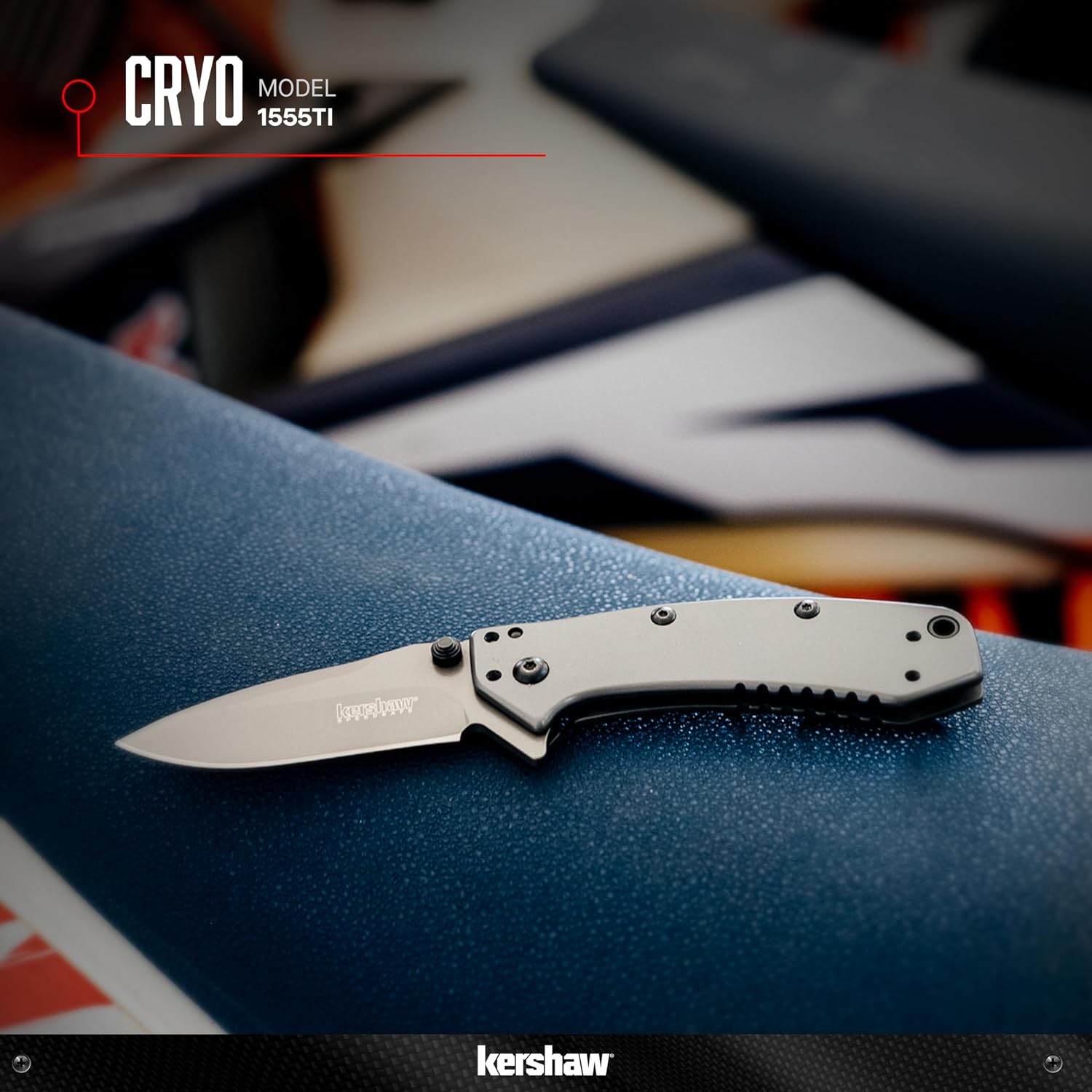
The Kershaw Cryo — a frame-lock folder in the $25–$35 range with 8Cr13MoV steel — frequently gets compared to the Spyderco Persistence and Delica 4 in buyer forums. The comparison is instructive because it clarifies what you’re actually paying for as you move up.
The Cryo and Persistence both carry similar blade lengths (~2.75 inches for the Cryo, ~2.75 inches for the Persistence in its standard configuration). The Persistence runs 8Cr13MoV like the Cryo. The Delica 4 steps up to VG-10, a Japanese stainless steel with meaningfully better edge retention and a finer grain structure. Across aggregated owner reports on BladeForums, the pattern is consistent: Cryo owners report satisfaction with daily light use but note the edge dulls faster than their Spyderco counterparts. Delica owners report stropping weekly rather than sharpening monthly. VG-10 is the reason.
The decision rule: If you sharpen regularly and aren’t precious about the process, the Cryo at $30 is an honest knife. If you’d rather spend 15 minutes with a strop once a week than 20 minutes on a stone once a month, the Delica 4’s price premium (~$80–$90) earns back its cost in convenience.
Frequently Asked Questions
Can a SpeedSafe assisted knife open accidentally in your pocket — and how do you prevent it? Yes, under specific circumstances — primarily when the flipper tab snags on pocket contents and applies enough force to engage the torsion bar. Prevention is simple: carry the knife in a dedicated pocket or pocket organizer, use a consistent tip-down orientation, and don’t mix it with loose keys or change. The mechanism is reliable in normal use; the risk is about pocket discipline, not product defect.
Is the Cold Steel Tri-Ad lock as strong as reviewers claim compared to a liner lock or axis lock? Based on published specs and consistent owner testimony across BladeForums, yes. The Tri-Ad’s stop pin prevents the rocking motion that can compromise standard back locks under lateral stress, and multiple long-form reviewers place it in the same tier as Benchmade’s Axis lock for real-world strength. The trade-off is one-hand closing — the Tri-Ad requires two hands to disengage.
What is 4Cr14 steel actually like in daily use — will it hold an edge at all? Knife Steel Nerds characterize 4Cr14MoV as low-chromium, low-carbon budget stainless that sits below 8Cr13MoV in both edge retention and hardness. It will hold an edge for light daily tasks — opening packages, cutting soft materials — but will dull noticeably faster than 8Cr13MoV or AUS-8 under any extended use. The upside: it’s extremely easy to sharpen, even on a basic rod. For a beater knife used in low-stakes situations, it’s functional. For anything requiring sustained edge performance, step up.
Is a sub-3-inch blade genuinely useful for real tasks or just a legal compromise? Genuinely useful for the vast majority of everyday cutting tasks. The limitation shows up only in sustained or heavy-material cutting — processing game, food prep for a group, splitting kindling — none of which belongs in a lightweight folder’s repertoire regardless of blade length. Outdoor Life’s EDC roundup puts the 2.75–3-inch range at the top of its utility-to-portability curve for everyday carry.
How does the Kershaw Cryo compare to the Spyderco Persistence or Delica at a similar size? The Cryo and Persistence carry similar steel (both 8Cr13MoV in standard configurations) and deliver similar real-world edge retention. The Delica 4 steps up to VG-10 and holds its edge meaningfully longer between sharpenings. Owner reports consistently describe the Delica as requiring less maintenance for equivalent use. If you sharpen on a schedule regardless, the Cryo’s lower price wins. If you’d rather strop than stone, the Delica earns its premium.
The Decision Framework
If you want the most satisfying sub-$40 EDC folder supported by the broadest owner consensus, the Kershaw Misdirect is where to start. If you have small hands or need deep-pocket invisibility, the Appa is the more precise fit. If lock strength is your primary criterion and you don’t mind two-hand closing, the Cold Steel Mini Recon 1 is genuinely hard to beat at its price. If you need a no-anxiety beater for shared use or rough environments, the Camshaft exists precisely for that role. And if the Clash appeals to you — the assisted opening is genuinely fast and satisfying — just carry it clean and it won’t cause problems.
The sub-$40 folder category rewards specificity. Know your use case, match the knife to it, and stop overthinking the price difference between tiers that may not matter for how you actually cut.