September 6, 2026 • Callum Reeve • 10 min reading time • Specs verified June 5, 2026
Whetstone Starter Kits Under $50: What First-Time Sharpeners Actually Experience
Whetstone Starter Kits Under $50: What First-Time Sharpeners Actually Experience
A whetstone — sometimes called a sharpening stone or water stone — is simply a rectangular block of abrasive material you use to grind a new edge onto a dull blade. You hold the knife at a consistent angle, move it across the wetted stone in controlled strokes, and the abrasive slowly removes metal until a fresh, sharp edge forms. It sounds straightforward. In practice, the first few sessions feel anything but. The angle wanders, the pressure is uneven, and the results can be humbling. That’s normal — and it’s exactly why the entry-level kit market exists. This article digs into what buyers of four popular sub-$50 kits actually report after weeks or months of use, names the tradeoffs honestly, and gives you a clear decision framework so you spend your money once.
If you already know your grits from your strops, skip to the section headers. If you’re newer to this, the short version: grit is how coarse or fine the stone is (lower number = coarser = removes metal faster; higher number = finer = polishes the edge). Most kits pair a coarser side (around 400–1000 grit) with a finer side (3000–6000 grit). You work through the grits in sequence, like sandpaper.
| EDITOR'S PICKShapton K0702 Blade | Mid-tierKING KW65 1000/6000 Grit Combin… | Budget pickKEENBEST Actual Grit Premium Ma… | |
|---|---|---|---|
| Grits | #1000 | 1000/6000 | 400/1000 |
| Base included | — | ✓ | ✓ |
| Base type | — | Plastic | Non-slip rubber |
| Combo stone | ✗ | ✓ | ✓ |
| Price | $38.93 | $37.44 | $9.99 |
| See on Amazon → | See on Amazon → | See on Amazon → |
What the Popular Kits Actually Are (And Where the Brand Premium Question Lives)
Let’s start with the honest structural observation, because it matters to how you shop.
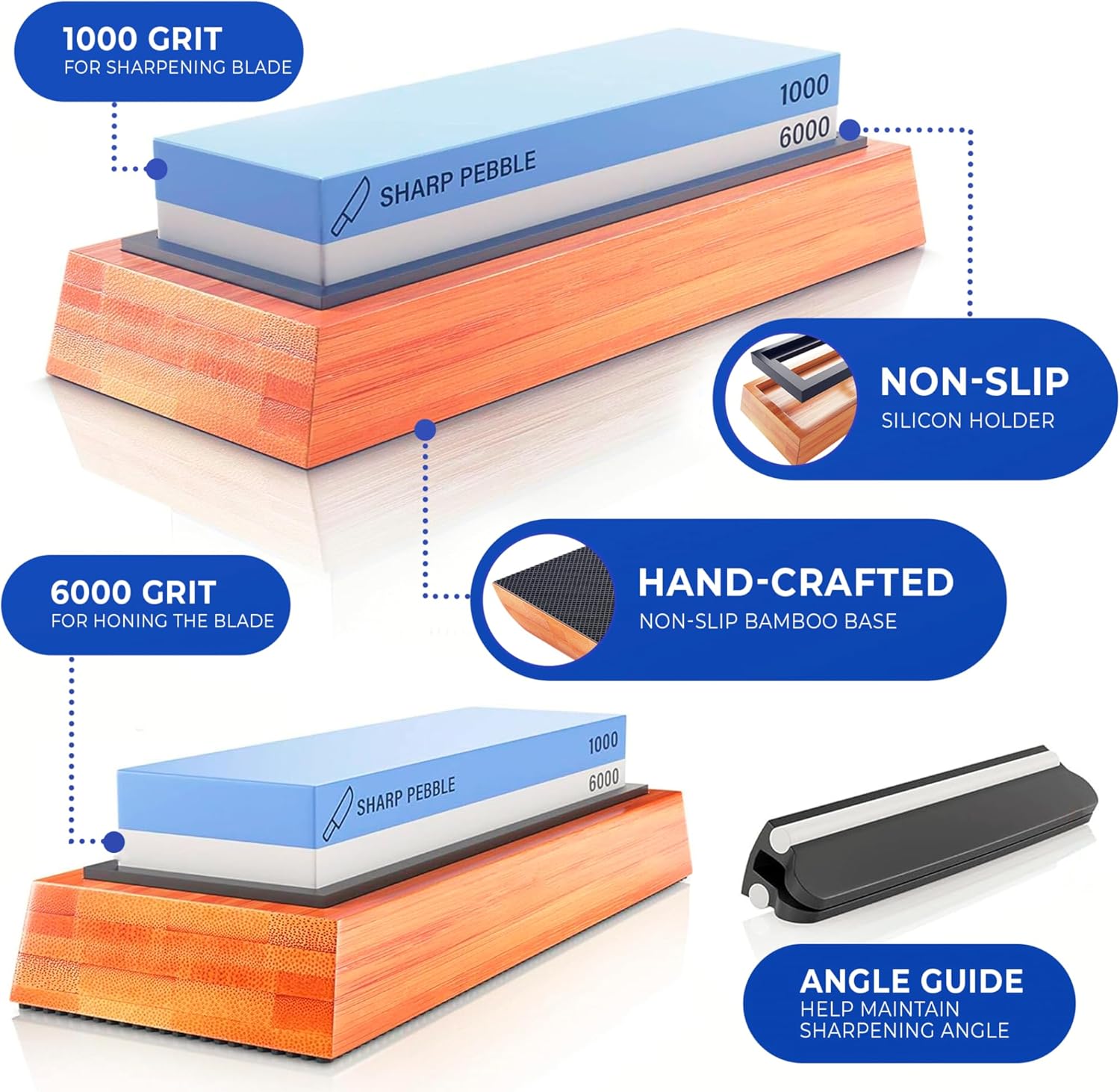
Sharp Pebble is the name most people encounter first — strong Amazon presence, polished packaging, a non-slip base, and an angle guide included. Reviewers consistently call it reliable and effective. Here’s the part worth knowing before you click: at least one detailed, credibly-written five-star review on the product page explicitly warns buyers that they may be paying a brand premium for a stone manufactured to the same generic specification you can find under other search terms — “combination whetstone 1000/6000,” for example — at a meaningfully lower price. That reviewer wasn’t unhappy with the stone itself; they were flagging the economics. That’s a fair warning. The Sharp Pebble kit earns its following because the packaging, the non-slip holder, and the included angle guide lower the barrier to entry. If you value a complete, ready-to-use kit with no sourcing homework, the premium is arguably justified. If you’re comfortable doing five minutes of comparison shopping, you may find equivalent abrasive performance under a less-marketed label.
Intelitopia takes a different angle: the set typically includes multiple stones covering a wider grit range plus a leather strop — the strop being a strip of leather used for the final alignment pass that makes an edge feel truly sharp rather than merely sharp-on-paper. That’s a legitimate kit for someone who wants to go from coarse grinding all the way to a polished, strop-finished edge without buying additional pieces. The concern worth flagging: one owner reported a chipped stone corner on unboxing. One incident in aggregated reviews isn’t a systemic failure, but it does suggest the stones are not as robust as premium Japanese water stones, and you should inspect yours on arrival. The inclusion of a strop at this price point is genuinely useful, not a gimmick — per KnifeInformer’s overview of whetstone progression, the strop stage is where a lot of beginners leave improvement on the table.
King KW65 is a Japanese water stone with a long reputation in the knife community. It’s a single stone, 1000 grit, and it requires a proper soak in water before use — typically ten to fifteen minutes. Owners on BladeForums describe the soaking ritual warmly, often framing it as part of a deliberate, meditative learning process. Many King KW65 buyers specifically chose it to avoid overspending while they determined whether sharpening was a skill they wanted to develop — a legitimate use of $25–$35. The stone’s softer binder means it releases abrasive particles during use (called “slurry”), which actually aids cutting speed. Knife Steel Nerds’ work on sharpening abrasives and steel removal rates notes that softer-bonded stones generate useful slurry, making them efficient at the 1000-grit stage even for steels in the mid-hardness range. The King KW65 is a real stone with real performance; it’s just one-dimensional by design, meaning you’ll need a finer stone to progress to a polished edge.
KEENBEST 400/1000 occupies a specific niche: rescue sharpening. Reviewers describe sharpening four kitchen knives in twenty minutes, starting from genuinely dull. That testimonial pattern — rapid results, lots of knives processed, minimal ceremony — identifies a results-first audience. The 400 grit side is aggressive enough to establish a new bevel on a neglected blade, which a 1000/6000 combo cannot do efficiently. If your household knives have gone embarrassingly dull or you’re starting from a chipped edge, the coarser entry point on the KEENBEST is the right tool. The tradeoff is finish: 400/1000 leaves a toothy, functional edge, not a refined one. For field knives and kitchen workhorse blades, that’s often enough. For a hunting knife or a premium EDC you want mirror-sharp, you’ll want to follow up on a finer stone.
The Real Unlock: YouTube, Not the Instructions
Across all four products, the single most consistent theme in owner reviews is this: the included instructions were not what taught them to sharpen. YouTube tutorials were. This is not a complaint — most buyers frame it neutrally or positively — but it’s a calibration worth making before you buy.
The instructions in budget kits are functional but thin. They describe the motion, mention an angle range (typically 15–20 degrees for most knives), and tell you to wet the stone. What they cannot replicate is watching someone maintain a consistent angle, hearing the scraping sound change as metal is removed, and seeing how the burr — that tiny wire of metal that forms on the opposite edge and signals you’ve ground enough on one side — actually feels against a thumbnail.
Per aggregated beginner threads on BladeForums spanning 2023–2025, the two tutorials most frequently cited as the actual learning moment involve slow-motion angle demonstration and explicit burr-checking instruction. Neither skill is stone-dependent. The King KW65 owner who gets thirty sessions of YouTube practice will out-sharpen the Sharp Pebble owner who relies on the included guide, every time. Skill is the variable; the $30–$50 kit is merely the substrate.
GearJunkie’s buying guide on whetstones echoes this: they recommend treating the first stone as a practice medium rather than a permanent toolkit cornerstone. Buy inexpensive, learn the mechanics, then decide what premium stones are worth when your technique is consistent enough to notice the difference.
By the Numbers: Kit Comparison at a Glance
| Kit | Grit Range | Strop Included | Soak Required | Best Use Case |
|---|---|---|---|---|
| Sharp Pebble 1000/6000 | 1000 / 6000 | No | Optional splash | Learning on a clean slate |
| Intelitopia Set | 400–3000+ / leather strop | Yes | Varies by stone | Full progression in one box |
| King KW65 | 1000 only | No | Yes (10–15 min) | Deliberate skill-building |
| KEENBEST 400/1000 | 400 / 1000 | No | Optional splash | Rescue sharpening, fast results |
Decision Framework: If X, Then Y
If you want one kit to start and nothing else: Sharp Pebble 1000/6000. The non-slip holder and angle guide lower friction in the first three sessions where most beginners quit. Accept that you may be paying a modest brand premium; the system cost is worth it as an onboarding tool.
If you want to sharpen outdoor and pocket knives to a refined edge from the first purchase: Intelitopia. The wider grit progression and leather strop let you finish a hunting or EDC blade properly. Inspect the stones on arrival and handle corners with care.
If you’re spending $25–$35 deliberately to learn before committing more: King KW65. One grit, proper soak, long history in the knife community. Pair it with YouTube and you’ll know in ten sessions whether sharpening is your thing.
If your immediate problem is four dull kitchen knives and you don’t want to spend an hour getting there: KEENBEST 400/1000. It will solve that problem fast. It is not a long-term fine-edge tool for premium blades.
Frequently Asked Questions
Do I need to soak every whetstone before use, or only some of them? Only some. Traditional Japanese water stones like the King KW65 benefit from a full soak — typically ten to fifteen minutes — because the water saturates a porous binder and keeps the surface lubricated throughout sharpening. Most synthetic combo stones in budget kits (including the Sharp Pebble and KEENBEST) are splash-and-go: a few drops of water on the surface is enough, and prolonged soaking can actually degrade their binders over time. Check the included documentation for your specific stone; if it says “splash only,” soaking is counterproductive.
Will a 1000/6000 combo stone handle a very dull or chipped blade, or do I need a coarser grit first? For a chipped blade or a bevel that needs significant reprofiling, 1000 grit will work but it will work slowly — potentially twenty to forty minutes of concentrated effort to establish a new bevel. A 400-grit stone does that same job in a fraction of the time. Wirecutter’s knife sharpener guide notes that 1000 grit is a reasonable starting point for a merely dull blade but not ideal for damage repair. If your blades are in rough shape, the KEENBEST 400/1000 or the Intelitopia set’s coarser stones are better entry points.
How fragile are budget combo stones — can they crack or chip in normal use? They can, and the Intelitopia corner-chip report is a useful data point here. Budget synthetic stones are not as dense or shock-resistant as premium Japanese water stones or Arkansas naturals. Dropping a budget stone on a tile floor is a legitimate cracking risk. In normal bench use — stone on a holder, knife moving across the face — they are stable. Store them wrapped or boxed rather than loose in a drawer, don’t drop them, and inspect corners on first unboxing.
Is the angle guide actually useful long-term, or just a beginner crutch? It’s a beginner tool, and that’s fine — that’s what it’s for. Experienced sharpeners on BladeForums and in long-run KnifeInformer discussions consistently report abandoning angle guides within a few months as muscle memory develops. The guide does teach you what the correct angle feels like, which is useful. The limitation is that it doesn’t account for blade curvature near the tip and can interrupt your stroke rhythm. Think of it as training wheels: use it without shame for the first ten to twenty sessions, then try freehand and notice how much of the angle-feel you’ve already internalized.
Are these kits suitable for sharpening outdoor and pocket knives, or mainly kitchen knives? Suitable, with one caveat: most reviewer testimony in this price tier comes from kitchen knife users, which biases the reported experience toward softer stainless steel. Outdoor and pocket knives — especially those in harder steels like CPM-3V, S35VN, or even a mid-tier steel like 154CM — will remove metal more slowly on a budget aluminum-oxide stone and may leave a less refined edge than on a premium water stone. The mechanics are identical; the time investment is longer and the finish ceiling is lower. For a Mora Companion or a mid-tier fixed blade, any of these kits will do useful work. For a Chris Reeve or a Bark River in a premium steel, the stones in these kits are adequate for maintenance sharpening between proper sessions on better abrasives — but they shouldn’t be your only sharpening option for high-investment blades.
The honest summary: at sub-$50, the stone matters less than the skill you build on it. Pick the kit that matches your immediate use case, pull up a slow-motion YouTube tutorial before your first session, and expect the first three or four sharpening attempts to be educational rather than impressive. That’s the normal arc, and every experienced sharpener on BladeForums started in exactly the same place.